Qbotica

Author: admin

  • Transforming the Industrial Manufacturing Supply Chain with Digital Innovation

    Transforming the Industrial Manufacturing Supply Chain with Digital Innovation

    Supply chain digital transformation is putting a colossal impact in an ever-transforming environment in industrial manufacturing. It is a process that entails application of digital technologies all the way down a supply chain of a company to render them more efficient and customer-valued.

    It is not merely acquiring new tools or software as it is more of a wholesome approach where the approach to doing things takes a new turn, new strategies and thinking has to be employed. It gives immediate access to supply chain data, analysis of the information, and enhanced cooperation by all parties interested.

    This paper will discuss the key factors, objectives, plan, and technologies that have led to the success of supply chain digital transformation. The particular focus will be on its impact and influence upon the industrial manufacturing supply chain. Since it is enhancing the manner in which things are being done to forging better relationships, this industry is being transformed, fully, by digital innovation, necessitating the like, as we have never before experienced.

    It is necessary to accept these changes whether it is a long time you have been working in this field or you are new in this field and would like to maintain the competition in this digital age. According to qBotica, it is most important to be more efficient and productive when it comes to solving problems by using intelligent automation.

    Now, here we are going to go together on this empirical voyage of transformation and creativity. We will find out the ways you can revolve your digital technology to significantly enhance your supply chain practices!

    Understanding Supply Chain Digital Transformation

    Supply chain digital transformation can be defined as the deployment of digital technologies into all activities of a supply chain process, including procurement to production through distribution. This is a changing process that faces operations and strategies in the digital possibilities context. It is eliminating traditional edges, establishing a networked, intelligent and a highly effective supply chain ecosystem.

    Benefits:

    Advantages of Supply Chain Digital Transformation.

    • Higher Productivity: Digital will ease operations, reduce manual work, and lower the probability of errors.
    • Data-Driven Decisions: Advanced data analytics are based on real-time using insights to drive the best decision-making.
    • Improved Agility: Businesses develop flexibility to respond promptly to any market disruption or change.
    • Cost Reduction: The optimization of the resources will result in a decrease in the general costs of operations.
    • Increased Transparency: The whole supply chain process is made entirely transparent which creates trust and accountability.

    Digitization of the supply chain within the manufacturing industry is not just a mere technological upgrade but rather a complete modification towards improved cooperation and the use of data in operations. The predictive analytics will help avoid delays, as an example, by predicting possible issues in the supply chain in advance.

    These changes are heavily dependent on technology. IoTs are used to track assets during transit, AI and ML models predict demand to keep the inventory at the optimal level, and blockchain is used to keep the transactions safe and enhance tracking of goods.

    As an example of the effectiveness of digital tools in practice, one can take a real-life scenario as one of the largest manufacturers achieved a solution that facilitated by qBotica allowed reducing the time spent on closing the month-end and significantly decreased the number of mistakes. In the same way, AI-enabled document processing such as DoqumentAI can revolutionize business activities by automating normal documentation tasks in an organization. Moreover, Robotic Process Automation (RPA) described in the insights of the qBotica on security in finance automation presupposes the change in the levels of compliance adherence and data integrity. The above examples are a clear indication that technology is not only an enabler but a catalyst of radical change in the digital supply chain context.

    Key Factors for Successful Supply Chain Digital Transformation

    Digital transformation in the area of supply chain success depends on a number of distinct factors.

    1. Enthusiastic Leadership Support

    The value of good leadership support cannot be expected. The leadership is critical to determining the vision, assembling the troops, and provision of the required resources to go through the digital transformation process. The journey to digitalization is usually full of hurdles and the leaders are the ones who are able to lead the organization through the hurdles and remain positive and focused within the teams. One of the brightest examples of such a strategy is the work of qBotica to pursue automation in healthcare by revenue cycle management.

    2. Cross-Functional Data Integration

    Second is the process of incorporating information to other functions and phases of the supply chain ecosystem. An effective digital supply chain requires availability of real time data on all aspects of the supply chain. The process of easy decision making, which is informed by the relevant data, is achievable due to this transparency, of which the benefits of intelligent automation by qBotica show how such an integration can have transformational impacts, including in finance and accounting.

    3. Predictive Issue Identification

    Finally, it is possible to use superior analytics and predictive systems to detect and nip the disruptions earlier before they become serious. By the early realization it will create sufficient time to take corrective measures, better cutting down on the downtime and enabling the flow of operations to continue smoothly. The case study reported on how qBotica assisted a government entity in enhancing efficiency by 99 percent shows a very good example in which predictive analytics can lead to efficiency.

    These three key elements combined would be the bedrock to achieving successful digital transformation within supply chains, thus offering better performance, efficiency, and competition.

    Goals of Supply Chain Digital Transformation in the Industrial Manufacturing Context

    Digital transformation is sought in the industrial manufacturing industry with a purpose of attaining certain performance results. Increased visibility of the supply chain processes is one of the major objectives. This is entailed by having knowledge in all areas of operation, procurement to product delivery. Visibility is not just an act of tracking; it entails acquiring valuable information which can be used in making a better decision and taking proactive action.

    The other important goal is to become more efficient. Technology is an important aspect of this as it facilitates automation and streamlining operations that lead to huge savings of time. An example of that would be the application of automation which can be especially adjustable in the rapid automation of the incoming customer requests, like address updating or service cancellations. In addition, these performance enhancements also play a significant role in the minimization of lead times both in the course of production and delivery. Peak reduction of delays enables the manufacturers to react in a short time to market volatiles and customer requirements in order to give them a competitive advantage.

    Moreover, the introduction of the digital transformation is critical in enhancing cooperation between all the participants in the supply chain. Through the use of digital channels and instruments, suppliers, partners, and customers can frictionlessly engage by exchanging information and knowledge that result in enhanced product creation processes and increase customer satisfaction rates.

    Effectively having such objectives factored into their digital transformation strategy should see industrial manufacturers enjoy the fruits of a genuinely transformed supply chain – according to the requirements of the current markets that are fast-moving, responsive, and sustainable.

    Digital Transformation Journey in the Supply Chain: Steps to Plan a Digital transformation.

    A digital transformation journey in terms of the supply chain is not something to be completed immediately. It has to be planned carefully and dotted with strategic decision-making and hassle-free implementation. The following are the major steps to be considered:

    1. Creating a Comprehensive Digital Transformation Roadmap

    You need a roadmap to ensure that the digital transformation undertakings and programs are aligned to your entire business goals and objectives. This strategic model must define the vision of your organization about its processes in a supply chain in the long term. The implementation of this road map will manage your change process and all the activities will go hand in hand with your objectives. As an example, when the issue at hand is the need to reduce the production and delivery lead times, you need to focus on digital solutions that are specifically able to bring about the desired improvement. According to Ezhil Arasan Babarani, the former CTO of qBotica, the automation strategies should be aligned to business objectives to be realized in a meaningful way. His observations can provide a lot of useful advice on how to implement automation in your supply chain successfully.

    2. Defining Quick-Win Opportunities.

    Find short-term wins within the first few months of your initiative to get momentum and internal support of the initiative. Such victories may be as basic as automating manual processes or opioid digital tools to gain more insight into supply chain operations.

    3. Comparing the Current Systems to Enhance them.

    Assess how old systems and technologies are and set the areas they should develop or procure new technologies. This action will entail an in-depth audit of your existing supply chain business and where savings or gaps can be improved through the application of digital innovation.

    As an example, an analysis of case studies of Intelligent Document Processing IDP solutions will shed more light on how companies have managed to change the way their organizations handle documents with digital technology

    4. Gaining Stakeholder Buy-In

    Digital transformation requires establishing a buy-in on the part of essential stakeholders throughout the organization. The stakeholders must realize the advantages of the changes, how they will affect their positions and what they can contribute to make the initiative.

    You have time to share your vision, hear the stakeholders and discuss any reservations and concerns. This will assist towards making a culture of change and motivating in the technological adoption within your organization.

    When making this trip, you need to remember that digital transformation is not only about adopting new technology, but also about transforming how your organization functions, as well as the way the organization thinks, to succeed in the digital world. When setting up and implementing your digital transformation process, think about how the automatic management of business documents developed through AI can help the business to simplify operations and become more efficient.

    Technologies Driving Digital Innovation in Supply Chain Management

    In their attempt to secure a fully-optimized supply chain, AI/ML-driven analytics are likely to emerge as central ones. Caliber requires businesses to explore the depths of their supply chain data; with the assistance of artificial intelligence (AI) and machine learning (ML), supply chains will reveal the gains that were not before possible to unlock. Such technologies enable decision-makers to have:

    • Demand forecast and inventory optimization prediction analytics.
    • The shipment and asset tracking have been taken in real time making it improve the management of logistics.
    • The proactive solution of the issues by identifying the bottlenecks and inefficiencies using automated methods.

    Innovative analytics is not only the ability to simplify the work, but also adhere to the vision of the customer experience, by providing personalized experience in delivering services.

    The digitization is not limited to the analysis of data, such technologies as IoT, blockchain, and cloud computing are essential. The IoT associates physical objects to the digital fiber enabling inspection with an unparalleled level of visibility throughout the supply chain. This connectivity is necessary so that:

    • Sensors will be able to track the conditions in real time and satirize the integrity of goods during transit.
    • Preemptive communication of machines on what is required to ensure their maintenance minimises the downtime.
    • Transformations on processes are made through collected data.

    Blockchain technology presents an element of safety and transparency to the online record of organizational processes in the chain supply system. It ensures:

    • Supplier responsibility and transparency.
    • Minimizing frauds and errors because of the infallibility of the blockgetName.

    Cloud computing is a scalable infrastructure that is in support of such technologies. Companies are advantaged with cloud services by:

    • Improved interaction among stakeholders despite the geographical jurisdiction.
    • Economical elasticity of operations to suit the evolving market needs.

    The combination of such complex technologies into the work of industrial production can not only help corporations remain on the same track but also make new standards of efficiency and prompt responses to the supply chain system.

    It might appear to be a challenging process to incorporate such innovations but organizations such as qBotica are doing their bit of encouraging developments in automation and intelligent systems through educating and mentoring communities in these developed areas. This community support can be viewed as a perfect example of the growing ecosystem focused on digital transformation promotion.

    An example to this is the successful application of their automation solutions to different fields like in the education sector where their bots have so far been applied in almost 200 or more schools and continue to multiply. Moreover, qBotica can deepen into the use of automation to perform more personalized services and increase the productivity of its agents in WebEx companies and achieve customer satisfaction with increasing expectations.

    Envisioning the Future of the Digitized Supply Chain in Industrial Manufacturing

    One of the strategies to remain ahead of the curve is the anticipation of the future. Therefore, the imagination of the supply chain in the future is vital to the industrial manufacturers who intend to remain on the edge in reference to its increasingly digitized world. It is not only about the use of digital technologies, but also about transforming the business models and business processes with the aim of turning them into a more responsive, transparent, and efficient supply chain.

    Consider having a supply chain which is run with minimum to no human input. Artificial intelligence enables automated processes to be more efficient, whereas AIs forecast and anticipate the collapse in advance. The capability of IoT allows tracking the resources in real-time, which is unprecedented in the whole chain of value. This is not a far off vision but the changing environment of the industrial manufacturing supply chain.

    Are you prepared to accept this digital future though? One of the most important steps to this transformation is the evaluation of business/technical capabilities of your organization. The first step is to determine your current digital maturity level, and follow a mapping of a realistic timetable of incremental development. Do not forget that it is not necessarily only about technology adoption; training new competencies and a culture of innovations are also crucial details.

    Breaking Down Silos for Greater Collaboration

    Innovation does not occur in compartments. The potential for cross-functional cooperation between supply chain and other divisions, such as R&D and marketing, is an important but frequently disregarded area. By destroying these silos and using shared knowledge, you can identify areas where you can improve otherwise. An example would be how combining the marketing campaigns with the supply chain strategies could help in responding to the market changes faster.

    The Proxy Importance of the Digital Transformation of Supply Chain Management.

    The one thing that is definite as we move into this digital era of interconnected processes and data-informed decisions is the fact that it will be critical to introduce digital change to supply chain management in a bid to enhance the competitiveness and performance of industrial manufacturing.

    Conclusion

    There is no doubt that digital innovation is on the rise and the supply chain operations of the industrial manufacturers have transformed due to this shift reflecting the technological capabilities of this age. In a more and more digital market, supply chain management that includes digital technologies carries better performance and competitiveness.

    Technologies such as qBotica offer smart automation solutions that are inspected based on stringent compliance principles such as the SOC 2 Type 1 certification of companies ready to make such a groundbreaking move. This certification ensures that the software solutions of qBotica meet the utmost requirement of security, availability, processing integrity, confidentiality, and privacy. It was awarded after it was evaluated by the American Institute of Certified Public Accountants (AICPA).

    Moreover, information on the way automated inventory control systems can enhance efficiency can be of that use. These systems have proven to be quite effective in reducing costs and streamlining the supply chain management processes. They provide a summary of how inventory control will revolutionize the operations of industrial manufacturers in future.

    The future of industrial manufacturing will be prompted by the level at which these innovations are embraced as the industries keep adapting in line with the development of the technologies. The decision-makers must act decisively. The services such as ones presented on the HR page on qBotica can work towards improving the workforce management due to the combination of state of the art technology with human expertise. The qBotica modern HR solutions are applied in enhancing the HR processes and increasing HR excellence within an organization through intelligent automated solutions.

    These digital transformations must be adopted in order to ensure that supply chains, and businesses, in the coming years will succeed.
  • Navigating the Future of Digital Transformation Engagements: The Role of Continuous Discovery Tools

    Navigating the Future of Digital Transformation Engagements: The Role of Continuous Discovery Tools

    In the rapidly evolving landscape of digital transformation, organizations are increasingly relying on continuous discovery tools to navigate the complexities of change. These tools represent a paradigm shift from traditional process discovery, as continuous discovery tools offer a strategic advantage, enabling companies to uncover insights, validate assumptions, and improve process solutions with stakeholders in real time.

    This article introduces the basics of the concepts and explores the pivotal role of continuous discovery tools in driving successful transformation engagements, highlighting their impact on process excellence.

    Digital Transformation And Process Excellence​​

    Digital Transformation is the integration of digital technologies in all areas of business to modernize legacy processes and applications executing those processes with the latest technologies like cloud, mobile, analytics, etc. The Transformation must begin with understanding the firm’s current operation and performance metrics and that’s exactly where process excellence fits in the picture.

    Process excellence emphasizes the efficiency, effectiveness, and productivity of processes by focusing on the continuous improvement of various tasks in the end-to-end process.

    Process excellence is key to successful Digital transformation Programs and having a continuous loop of process management will sustain and gain more improvements in process outcomes.

    For instance, before implementing a workday solution for automating the HR recruitment process, it is good to perform a process excellence engagement to streamline and improve the underlying recruitment processes.

    One of the most efficient methodologies for process excellence is to execute various stages of the Business Process Management (BPM) lifecycle in the chosen process area. Let’s get into the weeds.

    BPM Lifecycle Phases​

    BPM Lifecycle refers to the series of stages involved in managing and optimizing business processes within an organization. These stages typically include:

    1. Process Discovery​

    This phase involves identifying and documenting existing business processes within an organization.

    2. Process Analysis​

    The identified processes are analyzed in detail to identify inefficiencies, bottlenecks, and areas for improvement.

    3. Process Redesign​

    This phase involves redesigning and optimizing existing processes to improve efficiency, effectiveness, and alignment with organizational goals.

    4. Process Implementation​

    This phase involves implementing the changes across the organization.

    5. Process Monitoring​

    This phase involves continuously monitoring the performance of implemented processes to ensure they are achieving the desired outcomes and meeting organizational objectives.

    The scope of this article is to how the latest continuous discovery tools are helping organizations fast-track the Process discovery, Analysis, and Redesign phases of the BPM lifecycle and we will explore further in the rest of the article. Let’s start with a typical journey map of a BPM project that covers these 3 phases in the next section.

    Typical BPM Journey map​

    When a BPM process excellence team starts with the discovery phase they will:

    Identify the process area that is most troubling by interviewing business leaders.
    Conduct a process walk-through and workshop to identify the process steps from SMEs.
    Conduct interviews to map the end-to-end processes and identify Critical success factors.
    Map the AS-IS process and identify key tasks.
    Observe individual workers or agents in their day-to-day work to capture the KPIs.
    Perform manual process analysis by using traditional techniques like bottleneck, Pareto, lean Six Sigma tools, value mapping exercises etc.
    Improve the steps create a To-Be process and present the findings to the stakeholders.
    Repeat the steps from 1-7 to find additional improvement opportunities.
    Create a business case and manually prioritize the opportunities based on complexity and business value.
    Pick the ones that have a high ROI and faster time to market and create a project.

    Now that we understand the status quo let’s learn about continuous discovery.

    Continuous Discovery Approach​

    Continuous Discovery is an integrated approach that is automated by a tool that enables organizations to identify the current state of a business process holistically, and constantly understand how business KPIs are affected when actively applying process re-engineering and automation to achieve your business outcomes.

    Various vendors provide one or more tools and for our discussion, we will stick to UiPath Continuous discovery products as they have comprehensive sets of features to explain in detail.

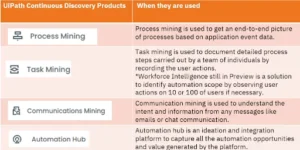
    Accelerate BPM phases using UiPath continuous discovery products – Each of the 4 UiPath continuous product suites helps with accelerating the Discovery, analysis, and redesign of the processes.

    • Process Discovery – Manual effort is replaced by automated discovery using the GenAI-powered tools like Process, Task, and communication and the baseline data is recorded as idea documents in the Automation hub for future reference.
    • Process Analysis – Manual Analysis has been replaced automated approach to finding the process variations, bottlenecks, inefficient checks, resource allocation issues, process conformance, etc. using advanced features provided in process mining or identifying customer sentiment and quality of service and 1 or 2-touch email tasks for automation as well using communication mining.
    • Process Redesign – Simulate redesign scenarios using process mining features to identify automation opportunities or use Task mining features to cocreate a To-Be process with the stakeholder before they are implemented and run mock user dry runs. The redesign Ideas are then recorded in the Automation hub for further implementation.

    Let’s finally see how these changes have impacted to creation of a discovery journey map compared to the above baseline journey map.

    New BPM Journey map​

    With the continuous discovery tools available, when a BPM process excellence team starts with the discovery phase they will:

    1. Identify the process area that is most troubling by using Workforce Intelligence in task mining applications.
    2. Conduct a process mining exercise to identify the AS-IS process steps of the identified scope.
    3. Conduct a Communication mining exercise as there are multiple communication channels involved in the process steps and use Gen AI capability to fast track the analysis setup.
    4. Share automation opportunities identified from communication analysis to the Automation hub.
    5. Analyze the outputs from the mining exercise to map the end-to-end processes and identify problem areas using the Gen AI capabilities and root cause analysis features.
    6. Use Process mining automation potential simulation capability to pick good candidates for task mining.
    7. Conduct Task mining exercises on the problem areas to get finer details of the issue.
    8. Analyze the task mining outputs to finalize the potential automation opportunities.
    9. Use the Task mining findings to create ideas in Automation Hub.
    10. Refine the idea identify the ROI of the automation and prioritize the automation projects.

    Now that we have covered all the topics let’s move to the conclusion.

    With the continuous discovery tools available, when a BPM process excellence team starts with the discovery phase they will:

    1. Identify the process area that is most troubling by using Workforce Intelligence in task mining applications.
    2. Conduct a process mining exercise to identify the AS-IS process steps of the identified scope.
    3. Conduct a Communication mining exercise as there are multiple communication channels involved in the process steps and use Gen AI capability to fast track the analysis setup.
    4. Share automation opportunities identified from communication analysis to the Automation hub.
    5. Analyze the outputs from the mining exercise to map the end-to-end processes and identify problem areas using the Gen AI capabilities and root cause analysis features.
    6. Use Process mining automation potential simulation capability to pick good candidates for task mining.
    7. Conduct Task mining exercises on the problem areas to get finer details of the issue.
    8. Analyze the task mining outputs to finalize the potential automation opportunities.
    9. Use the Task mining findings to create ideas in Automation Hub.
    10. Refine the idea identify the ROI of the automation and prioritize the automation projects.

    Now that we have covered all the topics let’s move to the conclusion.

    Conclusion​

    As organizations navigate the complexities of digital transformation, continuous discovery tools emerge as indispensable assets in their arsenal.

    In this article, we covered how different Continuous discovery tools empower teams to complete the process discovery, analysis, and redesign phases of the BPM lifecycle thereby accelerating the Digital transformation initiatives and improving the success rate of the programs.

    As the digital landscape continues to evolve at a rapid pace, organizations that prioritize continuous discovery will be better positioned to stay ahead of the curve, foster a culture of innovation, and achieve sustained success in the ever-changing business environment.

    To embark on your Continuous Discovery journey and unlock the full potential of your business, contact qBotica today. Our experts specialize in crafting tailored Continuous discovery solutions that drive tangible results and sustainable growth in your digital transformation or process excellence initiatives.


    Arunkumar Asokan

    Delivery Director, AI and Automation

  • How Robotic Process Automation (RPA) is Transforming Banking and Financial Services

    How Robotic Process Automation (RPA) is Transforming Banking and Financial Services

    Robotic Process Automation (RPA) is not the first technology that has changed the game in the banking and financial services sector, and emerging technologies have significantly transformed it. RPA in banking means computer algorithms, also known as bots that simulate human behavior through engagement with applications, eliciting reactions, and communicating with other systems.

    Simply put, RPA is an excellent automation tool where the rules are concerned -a capability that has been immensely useful in the banking industry. Automation of the banks routine operations has made it possible to concentrate the banks on value addition services and therefore improved their efficiency and customer satisfactions.

    In this article, the author explores the role of RPA in transforming banking automation as well as financial services automation. We will examine some of the features of RPA implementation in different banking functions like:

    • Account Opening
    • Know Your Customer (KYC) Check.
    • Customer Services
    • Compliance Monitoring
    • Payments.

    These are only a few of the spheres into which RPA has penetrated. Learn with us how RPA is transforming the banking processes, rendering them more efficient, enriching the customer experiences, and meeting the regulatory standards.


    The Role of RPA in Automating Banking Processes

    The concept of Robotic Process Automation (RPA) is transforming the conventional banking industry by mechanizing manual operations and procedures that were once time consuming and subject to human mistakes. This technology involves the use of software bots to imitate human behavior and interrelate with online systems thus effectively performing repetitive tasks.

    Examples of RPA in Banking

    The following are some of the concrete areas where RPA is taking a toll in the banking sector:

    1. Account Opening RPA streamlines the process of opening an account by automatically retrieving the customer information based on digital forms, data validation, and the establishment of new accounts on the core banking system.
    2. Know Your Customer (KYC) RPA bots can execute customer due diligence in KYC verification: they can gather information in several places, authenticate documentation, and identify any inconsistency.
    3. Customer Services RPA can support the provision of high-quality customer services through responding instantly to routine questions, addressing customer complaints, and fulfilling the requests related to balance checks or transferring funds.
    4. Compliance Monitoring To escape hefty fines, banks have to comply with a lot of regulations. They are able to automate the compliance reporting to manage change in regulations with RPA.
    5. Accounts Payable Management. RPA can be used within accounts payable management to automate invoice handling, vendor payments, and reconciliation to improve accuracy and efficiency.

    These examples allow us to understand that RPA is a game-changer in the banking industry. It does not only reduce the operation cost, but also improves the quality of services as well as compliance by reducing human intervention.


    Enhancing Operational Efficiency and Customer Experience through RPA in Banking

    Robotic Process Automation (RPA) has also opened up new levels of efficiency, especially where credit card processing, mortgage loan processing, and fraud detection are concerned.

    Credit Card Processing

    Regarding credit card processing, banks have to deal with many processes, involving the verification and authentication of customer data. RPA is capable of handling a lot of data in a short period; therefore, it saves time. The outcome is a faster credit card delivery, which makes customers happier and their resources more efficiently distributed.

    Mortgage Loan Processing

    The advantage spreads to the mortgage loan processing, too. The available automation simplifies the long and complicated process of mortgage approval. RPA robots are capable of executing duties like verifying a document, conducting credit checks and risk assessment in a very short period. This translates to quicker lending decisions with less possibility of human error.

    Fraud Detection

    RPA can process massive volumes of data quickly providing banks with an advantage in fraud detection. It helps highlight the red flags or anomalies which may indicate fraud. It is a proactive way of ensuring that risks are prevented before they can become major problems.

    These enhancements directly impact on operational costs. Less human work means fewer costs. One more area in which RPA performs well is error reduction; it reduces expensive errors that are part of the manual process.

    When seen through the lens of the customers, these efficiencies introduce smooth dealings with the banks. A better banking experience is aided by faster services, reduced errors and proactive risk management. Therefore, RPA is a revolutionary technology to improve operational efficiency and customer experience in the banking industry.


    Ensuring Compliance and Risk Management with Robotic Process Automation

    Compliance and risk management are not only a necessary evil in a highly controlled banking sector, but also the key element in ensuring the integrity of operations and trust. Robotic Process Automation comes in as a mighty companion, to replace the monotonous and rule-based activity to ensure the maintenance of high standards.


    The RPA and Compliance/Risk Management.

    The following are some of the specific ways RPA can help banks to ensure compliance and risk management:

    General ledger report automation.

    RPA can be used to automate the general ledger reporting process by entering and consolidating data. This accuracy helps to reduce the errors that may cause financial discrepancies or compliance problems. Banks can quickly get insight into their financial status in real time and take corrective measures where necessary.

    Account Closure Process

    Account closure is a delicate process that involves following several rules and regulations. RPA guarantees that all activities such as verification of client requests, transaction processing and closing transactions are done without exception and following the recommended procedures.

    Underwriter Support

    RPA helps underwriters in automating repetitive activities including collecting and analyzing data, which is essential in determining the risks involved in lending. With the help of RPA, banks can make risk assessment not only rigorous and objective but also more informed.

    These solutions are beneficial to banks in two ways as they are incorporated into the banking process: they strengthen the compliance system and release human resources to more valuable and sophisticated work. This not only minimizes the chances of incurring expensive regulatory violations, but also boosts the general strategic capacity of financial institutions in the field of risk management.


    Streamlining Regulatory Compliance and Customer Onboarding with RPA

    The onboarding process is a crucial concern as banks are working toward delivering seamless customer experiences to their clients. The traditional onboarding approach can be long and painful, and can lead to customer loss of interest and attrition. It is at this point that Robotic Process Automation (RPA) comes in to transform the onboarding experience into an efficient process.

    How RPA Improves Customer Onboarding

    RPA is used to support banks in automation of the repetitive tasks associated with customer onboarding, data entry, and document validation. This automation not only saves time in delivering the services to the new customers, but also, reduces the number of errors that arise as a result of manual entries.

    The Benefits of RPA in KYC Verification

    One of the most significant steps to customer onboarding is the Know Your Customer (KYC) verification. Traditionally, KYC has always taken time, two way traffic and a lot of paper work. The RPA could help to automate the KYC mechanisms, including data collection, identity verification, risk management, and data integration. With this, banks can do KYC faster and more accurately.

    Enhancing Regulatory Compliance with RPA

    The other area in which RPA proves to be of immense value is in ensuring regulatory compliance. The environment that banks operate in is constantly changing due to rules and regulations that require a bank to report on time and keep records carefully. These tasks can be automated with an RPA solution to ensure accuracy and consistency in regulatory reporting and also to free up resources to more strategic efforts.

    RPA is another key step towards efficiency and customer-centricity of its activities in a bank, as it reverses the customer onboarding process and helps banking companies comply with regulations.

    RPA in Banking

    Overcoming Challenges in Successful RPA Implementation

    There is a fair share of challenges that come up with the implementation of Robotic Process Automation (RPA) in the banking industry. The following are some of the main challenges and ways of overcoming them:

    Which Processes to Automate.

    It might not be easy to determine the relevant processes that need to be automated. It is about listening to process volume, complexity and standardization. Process assessment is thus a significant process to identify areas that can be automated.

    Achieving Stakeholder Engagement.

    The other important factor is stakeholder involvement. The successful deployment of RPA requires the involvement of all stakeholders including the top management and the employees at the operational level. This collaboration will help align the RPA projects with the overall strategic goals of the bank and help manage change in a manner as seamless as possible.

    Training Workers into New Jobs.

    With the changing roles that come with automation, training programs to help equip employees with the relevant skills in their new positions are necessary.

    Creating an Automation Roadmap.

    To successfully adopt RPA, it is necessary to develop an automation roadmap. A strategic roadmap is a tool, it provides a certain plan, a clear milestones and goals, hence making it easy to execute it.

    Forming a coalition with Technology Providers.

    Lastly, collaboration with the appropriate technology vendors is a critical component of design and implementation support. The appropriate technology provider may provide professional advice, assisting banks in overcoming the RPA implementation challenge.

    Ability to confront these problems directly, banks will be able to use RPA to help them to reach a high level of efficiency in their work and their relationships with customers. The payoffs of adopting RPA can be enjoyed with proper planning and execution by people willing to adopt the groundbreaking technology.


    Future Directions: The Evolving Landscape of RPA in Banking and Financial Services

    Financial services and banking field is also witnessing increased use of Robotic Process Automation (RPA), that will be improved with artificial intelligence in the near future. This will be succeeded by the next wave of automation in the financial services sector as intelligent automation in banks becomes combined with other advanced technologies, such as machine learning (ML) and natural language processing (NLP).

    Intelligent Automation and Cognitive RPA Capabilities

    • Better Decision-Making: With RPA, machine learning algorithms enable a system to arrive at complex decisions based on data trends. Credit scoring or personal financial advice processes may prove immensely useful with such intelligent automation.
    • Process Optimization: Cognitive RPA is not limited to rule-based work, but it reacts to change and acquires knowledge through unstructured data. Such flexibility can lead to autonomous process improvements that can lower the need to intervene with a human.
    • Intelligent Analytics: ML-driven RPA-based solutions can apply to high volumes of transaction data to deliver predictive information to support banks to deploy risk management and fraud detection approaches.

    Leveraging Advanced Technologies for Greater Business Value

    1. Customer Engagement: With the help of NLP, chatbots are capable of addressing more complex customer questions. This technology does not only help to improve customer service but also releases human resources to other complex tasks.
    2. Process Efficiency: ML+RPA can streamline internal operations by discovering bottlenecks and proposing ways to improve them, leading to process efficiency throughout banking activities.

    As you look at these developments it is clear that the banks are about to take a radically new step towards more autonomous operation. These technologies would change the efficiency and customer satisfaction industry norms.


    Transforming the Banking and Finance Industry with qBotica’s Automation Solutions

    qBotica is set to be a leader in the adoption of RPA and intelligent automation solutions that offer banks and other financial institutions the tools they require to deal with the pressures of the digital era. They extend their automation beyond traditional RPA by incorporating artificial intelligence (AI), machine learning (ML), and natural language processing (NLP) to provide more intelligent and cognitive automation features.

    Their solutions will automate most of the banking functions such as opening accounts, verifying KYC, customer support, monitoring compliance, and payable management to mention a few. By doing so, qBotica would not only simplify such operations, but automate them into innovation opportunities and better service delivery.

    Conclusion

    Robotic Process Automation (RPA) is proving to be a useful tool in the banking and financial services sector as we continue to move further into the realm of digital transformation. It is being used to automate standard operations, improve customer services and regulatory compliance. The advantages of RPA use in banking are obvious:

    1. Innovation: RPA software can help banks to reshape their operations and discover new avenues to expand.
    2. Efficiency: RPA is faster and less prone to errors as it automates manual processes, therefore enabling employees to work on more valuable and relevant tasks.
    3. Customer-Centricity: The banks can significantly improve the customer experience with the help of faster and more reliable services.

    Not only are these benefits effective in enhancing the work of banks, but they also show a positive influence on employees, stakeholders, and the overall business performance.

    It should be noted, though, that the successful implementation of RPA demands planning, evaluation, and engagement of all parties involved. Another important thing is to select the appropriate technology partner with whom you can discuss your particular needs and agree on specific solutions.

    You will find yourself in many situations navigating through the turbulence of digital transformation, a path in which you can use the strength of RPA within your organization. It is a powerful tool that can ensure you build up and stay ahead of the competition. You need to welcome change, give your employees innovative technology, and observe as your organization realizes new heights of success.

    Find out how qBotica can speed up AI-driven change and help your business get real results.Here, you can find out more about qBotica’s smart automation and digital transformation solutions.

    Follow us on LinkedIn and check out our Insights Hub to stay up to date on the latest news and information from qBotica.If you want to know more, please get in touch with the qBotica Marketing Team at 

     +1 (623) 252-6597 or

     marketing@qbotica.com. 

    https://www.qbotica.com

  • Revolutionizing Healthcare: The Pivotal Role of Revenue Cycle Management

    Revolutionizing Healthcare: The Pivotal Role of Revenue Cycle Management

    In the modern healthcare setting, the role played by revenue cycle management (RCM) cannot be underestimated. It is the foundation that allows medical facilities to be financially healthy and effectively operating so that they can concentrate on providing quality patient care.

    However, what is RCM, and why is it so important to health care professionals? We would like to immerse ourselves into the reality of RCM, unmask its secrets, and see how automation and specialized services are transforming its future.


    The Revenue Cycle Management in Healthcare, unpacked

    Revenue Cycle Management (RCM) in healthcare is a complex, and vital procedure, which forms part of the management and financial performance of healthcare providers. This is an all inclusive mechanism that involves a number of phases, each of which is critical in making sure that services provided by the health care professionals are fairly compensated promptly and effectively. Here’s a deeper dive into RCM:

    Comprehensive Process

    Revenue Cycle Management is a comprehensive methodology, which entails a number of key steps, starting with the first interaction with a patient and ending with the receipt of payment. This process includes:

    • Patient Registration: The initial step in the process is when a patient reserves an appointment: it is the first stage of data capture and it preconditions the billing cycle.
    • Subject to Insurance: It is important to check the insurance of the patient prior to the delivery of services to ensure that services are paid.
    • Charge Capture and Coding: The services given are coded into standardized codes after treatment has been administered which is a mandatory requirement during billing and filing of claims.
    • Submission of Claims: Claims are then submitted to insurance companies with these codes to be paid the amount of money to be paid because of the health care services offered.
    • Payment Processing: Payment processing is done when approvals are made to claims and any patient responsibility (e.g., co-pays, deductibles) is ascertained.
    • Balance Settlement: This is the last stage where any leftover balance of the patient is obtained and the billing cycle is closed.

    Utilizes Medical Billing Software:

    The contemporary Revenue Cycle Management involves medical billing software that is highly specialized in order to provide smoothness at every stage of the cycle. This software:

    • Improves the accuracy in terms of minimizing errors in coding and billing.
    • Streamlines the claims filing procedure that increases faster reimbursements.
    • Provides real-time monitoring and reporting which assist the providers to manage their finances in a better way.

    Tracks Patient Care Episodes:

    Revenue Cycle Management is a careful tracker and manager of financial details of patient care episodes starting all the way up to the end-of-the-pocket payment. Continuous monitoring will guarantee:

    • Openness of the patient experience.
    • Efficient patient accounts and billing information management.
    • Better patient satisfaction by better communication and billing.

    Assures Timely and Effective Remuneration:

    The final aim of Revenue Cycle Management is to make sure that the healthcare providers do not receive unjust payments due to the redundant delays. This is accomplished by effective RCM by:

    • Reducing the rejections to claims with proper coding and submission.
    • Simplify the payment process by the insurers and patients.
    • Increasing the rate of revenue and decreasing the amount of time between service and payment.

    The Important Work of a Revenue Cycle Manager

    The revenue cycle manager is at the core of effective healthcare financial business. This professional is not a mere cog in the machine, he/she is the navigator of the ship of Revenue Cycle Management in the stormy waters. The main responsibilities of them, and the effect they have on the healthcare facilities, will be unpacked:

    Cohesive Operation Assurance

    The corresponding role of the revenue cycle manager is to make sure that the process of RCM proceeds without any incident, starting the registration of a patient to the point when the final payment is received.

    Managing the twists and turns in Healthcare Billing

    • Registration of patients: They ensure that patient records and insurance information are correct thus predetermining an efficient billing procedure.
    • Charge Capture: It is important to make sure that the services are well documented and billed. They keep track of the charge capturing process in order to avoid revenue leakage.
    • Submission of Claims: They assist in timely and proper submission of claims to the insurance companies minimizing chances of deniability.
    • Payment Posting: The efficient posting of payment to patient accounts is managed in order to maintain financial records.
    • Denial Management: In case of claims being denied, they would be the first to investigate and fix the problems and reclaim the lost revenue.

    Optimizing Revenue

    In their overall management, revenue cycle managers utilize measures that ensure maximum revenue increases. They find areas of improvement, stream billing operations and make sure that the billing practice is in line with regulation provisions.

    Reducing Billing Errors

    Having a keen eye to detail, they are very critical and would help reduce billing mistakes. This includes regular audits, training of staff and revision of billing practices in line with current standards and regulations that pertain to billing.

    Improving Financial Operations

    Their work will help in facilitating financial operations in a healthcare facility by:

    • Shortening time of service delivery to payment collection.
    • Enhancing cash flow by the use of effective billing and collection procedures.
    • Improving patient satisfaction through accurate and transparent billing.

    Teamwork and Cooperation

    Revenue cycle managers play a key role in ensuring that staff members of the clinical and administrative units communicate effectively. They will make sure that all people are in line with the financial objectives and compliance standards of the facility.

    Staying Ahead of the Curve

    They stay updated on any changes in healthcare legislation, regulations and technology that may affect RCM. They maintain their facility updated, thereby ensuring that they adjust to a changing environment in the healthcare system.

    Revenue Cycle Management

    A Closer look at the Revenue Cycle Management in Medical Billing

    Wearing the confusing hat of RCM in medical billing and revenue cycle management in medical billing, one will unavoidably discover a vital element at the core of the financial ecosystem of healthcare.

    These are not just administrative processes, but they are lifelines that enable healthcare providers to be financially stable and at the same time provide quality care. The critical importance of such processes can be explained by the knowledge of the peculiarities of their working.


    The Essence of Revenue Cycle Management in Healthcare

    The healthcare sector is effectively the whole of financial management of receiving money in relation to patient billing including the pre-appointment booking process to the end stages of receiving the bill.

    Through this, all the services offered will be properly billed and reimbursed, reducing the chances of the company losing money as a result of missing an opportunity to receive a payment or because a bill was not filled appropriately.

    Improving on Claims and Payments

    Effective RCM processes can play a significant role in simplifying the claims management so that claims are correctly and on time submitted. This entails painstaking recording and coding of services rendered that is very important in avoiding claim denials. Effective claims management is directly linked to faster reimbursements; this is crucial to the liquidity of healthcare providers.

    Increasing Billing Effectiveness

    The RCM billing factor is also essential. It deals with the creation of patient bills, receiving payments and balancing of patient accounts.

    Through the implementation of effective billing, healthcare providers have gained a lot of time between the service provision and the time of receiving payment. This is not only efficient in improving its cash flow but also in increasing patient satisfaction through the presentation of accurate and clear billing statements.

    The Implication on Healthcare Providers

    The potential of proper revenue cycle management in medical billing among healthcare providers cannot be underestimated. RCM has a direct impact on the sustainability of a provider to remain in business and provide quality care without interruption since it ensures that claims, payments, and billings are completed more efficiently.

    Financial margins in a sector, especially in a highly competitive one, can be tight; optimization of such processes may be the difference between success and just survival.

    Banking and Business Continuity

    As a result of financial stability, which is granted by effective RCM, healthcare providers can invest in modern medical technologies, attract the best medical personnel, and increase their services to satisfy their community needs. It makes sure that it has resources that are not only meant to support its day-to-day activities but also its strategic growth programs.

    Ensuring High-Quality Care

    Further, the economic stability achieved by proper RCM practices enables the providers to concentrate on their main task, which is to provide high-quality care to the patients. When the economic component of the healthcare system is effectively handled, the medical workers can focus on the patients more than be preoccupied with the financial paperwork of healthcare administration.

    RCM Evolution: Automation and Leading the Pack with qBotica

    The introduction of automation technologies in the quest to pursue excellence in healthcare revenue cycle management (RCM), has been revolutionary indeed.

    With the healthcare sector confronting the mounting pressures, stricter regulations, and the ever-present need to save money and improve patient care, the importance of technology, in particular automation, has become especially crucial.

    Innovators such as qBotica are guiding this change as their innovative solutions are establishing new standards of efficiency and accuracy in the RCM processes.

    The Implication of Automation on Revenue Cycle Management

    The effect of automation on RCM that is driven by the innovations of qBotica is massive. Healthcare providers who adopt such solutions find a tremendous decrease in errors in billing, decrease in the time it takes to process claims, and increased patient satisfaction because of better and clearer billing practices.

    In addition, automation liberates useful human resource, which can be utilized by experienced professionals in more strategic activities that benefit both the healthcare provider and the patients.

    Additionally, due to the focus on innovation, qBotica is constantly upgrading their solutions, and they listen to their healthcare providers and make their services even more effective.

    This type of partnership is one that does not only guarantee that the solutions of qBotica are at the forefront of technology but also solidifies its position as a reliable advisor in the RCM arena.

    Future Prospects: The Future of Automated RCM

    The future of the revenue cycle management is directly associated with the progress in the automation field as well as the further innovations made by such leaders as qBotica. Technology will continue to change and so will strategies and solutions that can be used to optimize RCM processes.

    The opportunities of AI and ML further incorporation into RCM are immense with predictive analytics of patient financial responsibility and blockchain of safe and open transactions.

    The relevance of automation in the operational excellence and financial standing of the healthcare providers will not be disputable in the future. As qBotica is on the front line, the process of complete automation of, efficient and error free RCM processes is not only a possibility, but it is coming to pass.

    qBotica: One of the Leaders of Revenue Cycle Management Automation

    qBotica becomes a leader in this transformational landscape, a leader of innovation in medical services around the area of RCM. qBotica is a company, which has a sharp aim at focusing on the use of Artificial Intelligence (AI) and Machine Learning (ML) to provide a series of automation initiatives aimed at addressing the most acute issues of Revenue Cycle Management (RCM).

    The solutions provided by qBotica offer a high level of customization to improve each part of the revenue cycle, whether it comes to automating the process of patient registration and verification, simplifying the process of submitting claims and processing payments.


    Conclusion

    The importance of revenue cycle management in the healthcare sector cannot be undermined. It is critical to the financial health and performance of healthcare providers. RCM in the future, with advanced technologies and professionalism of such companies as qBotica, is not only not bad, but a revolution. Automation of RCM is not just a tendency, it is the next stage of more effective, open, and patient-centered healthcare.

    Find out how qBotica can speed up AI-driven change and help your business get real results. Here, you can find out more about qBotica’s smart automation and digital transformation solutions.

    Follow us on LinkedIn and check out our Insights Hub to stay up to date on the latest news and information from qBotica. If you want to know more, please get in touch with the qBotica Marketing Team at

    +1 (623) 252-6597 or

    marketing@qbotica.com.

    https://www.qbotica.com

  • Revolutionizing Denial Management: Unlocking Maximum Revenue in Healthcare

    Revolutionizing Denial Management: Unlocking Maximum Revenue in Healthcare

    The complicated healthcare environment has become the place where denial management has become the basis of efficient medical billing and financial sustainability. This is a vital operation that entails the detection, fixing, and averting of insurance premiums and claims denials, and assurance that medical care givers attain complete and punctual service payments.

    As automation and technology continue to evolve, such companies as qBotica are on the forefront in changing the denial management in medical billing by coming up with new innovative solutions. The blog explores the intricacies of the nature of denial management, its relevance, and difficulty, as well as the transformational ability of automation denial management

    Denial Management in the Realm of EHR

    Denial management is a process of paramount importance to the healthcare sector, which is concerned with a painstaking activity of investigating, correcting and challenging the cases of claim rejection.

    In its most basic form, it represents a preventive strategy, which seeks to reduce financial losses and maximize the effectiveness of the revenue cycle. The importance of denial management in the medical field is insurmountable, which directly translates to the financial standing of a healthcare professional and the quality of his services as a medical professional.

    This is a crucial process that takes off once a claim has been rejected and it initiates a chain of investigative moves to figure out the cause of the rejection. Regardless of the causes of coding errors, the lack of patient information, or a disparity in insurance coverage, any denial is a chance to correct an immediate problem along with enhancing the billing process in the future to prevent similar mistakes.

    Healthcare organizations adopt the strategies of denial management to be on a journey that will protect their revenue streams. It is not just a contesting denials. It is the introduction of the culture of accuracy, responsibility, and constant improvement.

    Proper management of denials in medical billing is a pillar towards financial health sustainability and ensuring that resources are used in the promotion of patient care instead of going through the bureaucratic bottlenecks.

    The High Denial of Costs of Claims

    The financial consequences of claim denied cases are extremely harsh on healthcare providers each year. These refusals in medical billing tendencies can often be narrowed down to either the error in coding, absence of patient data, or the problem with insurance policies.

    This kind of insurance denial is not a simple hiccup to the revenue stream but is a domino that affects many aspects of healthcare administration and delivery.

    It is not only the numbers on a balance sheet that make that financial burden that these denials create. It is not merely about the money that might have been lost due to the denying of a claim, even though the services are already rendered.

    it has to do with the extra resources that should be invested to accommodate such denials. Employees who might otherwise be attending patients or doing other important tasks are also distracted by the complicated appeals procedure that may also be time-consuming and confusing.

    To solve the problem of the denial of claims, it is necessary to take a careful approach to medical billing, not only checking the validity of all the information about the patient provided but also keeping up with current trends in coding regulations and insurance coverage. The stakes are really high, and the prices of refusals are much bigger than the financial costs, as the core of the healthcare service provision and the quality of patient care.

    The Major Strategies of effective denial management

    Prevention: Best Practices in Submission of Claims.

    In order to reduce the possibility of claims being rejected, the medical professionals should embrace thorough documentation procedures, proper coding, and checking of insurance eligibility prior to the delivery of services. With the value of managing services of coding denials, prevention is the initial step towards counter-denial.

    Resolution: What to Do when a Claim is Rejected.

    In an instance of a claim that is rejected, there is the need to act quickly. This is done by examining the reason for denial, assembling the relevant documents and filing an appeal. This can be quickened by using specialized denial management services, where such potential losses would be converted into recoverable revenue.

    Analysis: Determining Trends of Denials

    One of the key elements of managing denials is the analysis of the patterns of denials to avoid such future occurrences. Using data analytics, healthcare providers have the opportunity to identify systemic problems, be it in the field of denying the code of services or the verification of eligibility of patients and introduce specific changes.

    The Role of Automation in Denial Management

    With the incorporation of automation in the world of denial management, it has altered the manner in which healthcare providers deal with the issue of claim denials. Denial management software and automation have not only facilitated operations but also have provided an avenue of reducing the levels of denied claims towards a greater percentage.

    A closer examination of how automation is transforming the process of denial management in medical billing is as follows:

    Automated Claim Tracking

    Denied claims can be identified by automated systems as they go through the lifecycle of the claims. This real time tracking has made sure that none of the denied claims is left without being noticed and that action is taken in time.

    Denial Patterns Identification.

    Data analytics can help the denial management software detect the common causes of claim rejections. This understanding can enable healthcare providers to fix systemic problems, which will minimize chances of future denials.

    Quick and Smooth Appeals Process.

    The appeals are simplified by automation, through generation and submission of appeal letters depending on the reasons why they were denied. This saves the time needed to manually do it and the time of resolution is fastened.

    Increased Accuracy and Compliance.

    The automated systems assist with removing chances of claims being rejected based on the error or the out of date information, and this is done by making sure that the claims are accurate and in line with the latest coding standards and payer policies.

    Predictive Analytics

    The denial management software can predict future denials and prevent them before they occur by using predictive analytics to enable healthcare providers to rectify the situation in advance

    Improved Financial Health

    Automation leads to the financial health and efficiency of a healthcare provider through improved claim denial rate and facilitating the process of handling problems.

    Focus on Patient Care

    Automation releases personnel out of the tedious manual work related to denial management and enables them to concentrate more on patient care, among other essential functions.

    Electronic Health Records (EHR) Integration.

    A variety of automated solutions in the system of denial management can be easily incorporated into the EHR system, which contributes to the more efficient and accurate work of the billing system even further.

    Solutions in Healthcare Automation of qBotica

    qBotica is a trailblazer in terms of changing the healthcare billing and denial management procedures. qBotica provides powerful answers to the complicated problems of denial management in the process of medical billing by using modern state-of-the-art automation technologies. How the innovative approach of qBotica is making a difference we should break it down:

    Denial Management Services (Complete):

    • Proactive Denial Prevention: Predictive analytics which deliver a prediction of possible claim denials and avert them in advance.
    • Efficient Denial Resolution: Automating the claim rejection process and simplifying the process of resolving claims.

    Complex Denial Management Software:

    • Mechanization of Monotonous Services: Monotonous services like submitting claims, and following-ups ought to be automated so that staff is able to focus on more intensive and patient-focused services.
    • Real-time Analytics and Reporting: This will give real-time insights on the causes, trends of denials, which will guide healthcare providers to make effective decisions and plans on how to reduce denials.

    Enhanced Financial Health:

    • Enhanced Cash Flow: With less frequent claim denials, there will be better and improved cash flow which is necessary to the financial stability of the healthcare providers.
    • Higher Revenue Recovery: qBotica encourages the recovery of lost revenues otherwise with resultant positive effects on the bottom line by means of effective management and appealing of denials.

    Focus on Patient Care:

    • Less Administrative Load: Automating the denial management process will help the healthcare staff to shorten their attention span towards back office activities and shifting it to quality patient care.
    • Greater Patient Satisfaction: The fact that it takes shorter time to process claims and fewer errors in billing leads to a smoother patient experience, which increases patient satisfaction.

    Scalable Solutions:

    • Scalable to Need: qBotica solutions are customizable to the needs of small or large healthcare systems, and can be expanded or optimized to the needs and the volume of any healthcare system.
    • Future-Ready Technology: Keeping the pace with constant changes and additions to address the new challenges and regulations in healthcare billing and insurance.

    The healthcare automation solutions of qBotica are not merely a collection of tools, but an alliance in achieving efficiency and effectiveness in the process of billing and denial management of healthcare providers. Through adoption of the innovative solutions of qBotica, medical practitioners can make sure their performance is geared towards financial prosperity and committed to providing the best care to the patient.

    Living in the Future: Denial Management and Technology

    The healthcare sector is undergoing a torrent change which has been affected by improved technology and healthcare billing patterns. The future of applying technology in handling the processes of denial is not only essential but also a good thing as we look towards the future. The following are some of the important elements of the way this evolution is shaping and what we may look forward to in the next several years:

    The Changing Healthcare Billing Environment.

    • Greater Automation: It is also unavoidable that more automated systems are used in tracking, submitting, and managing claims. This involves the application of AI and machine learning algorithms to predict and avoid denials before they take place.
    • Electronic Health Records (EHR) Integration: Fluent communication between EHR systems and billing procedures will be regarded as a matter of standard, which will eliminate any errors in manual entry and enhance accuracy of claims.
    • Real-Time Adjudication: There is also an attempt to do real-time claim adjudication where immediate feedback on accepted or rejected claims will be provided, thereby making the denied claims take much shorter time to be resolved.

    Future Projections in Future Denial Management.

    • Predictive Analytics: With the help of big data and predictive analytics, the patterns of potential claim denials are determined, and healthcare providers can fix the problem before it occurs.
    • Blockchain as a Transparency Aid: Use of blockchain technology may bring a new level of visibility and safety in claim transactions that will reduce disagreements and refusals based on misunderstanding or lack of data.
    • Patient-Centric Billing: A shift to more patient-centric billing and communication, which enables patients to gain a better understanding of their coverage and minimize billing denials caused by eligibility and authorization problems.
    • Tailored Denial management Solutions: With the increasing complexity of operations within the healthcare provider, tailored denial management solutions to a particular need are to be increased. The solutions will provide flexibility in dealing with the unique problems encountered by providers.

    Roles of Adapting to Denial Management Technologically Driven.

    • Healthcare IT Specialists: With the increased use of technology in healthcare processes, the number of IT specialists required due to their knowledge of healthcare systems, data analysis, and cybersecurity will increase.
    • Denial Management Analysts: Experts in the field of denial trends analysis and solutions to curb such problems will come in handy. They will use technology to automate the denial management process.
    • Patient Advocates: In a patient-centered model, the functions of advising the patients in the specifics of healthcare billing and insurance coverage will be increasingly necessary to make them aware of their rights and opportunities.
    • Regulatory Compliance Experts: With the constantly changing healthcare requirements, it will be necessary to have specific professionals who can ensure that the denial management practices do not contravene the current legal and compliance requirements.

    Conclusion

    Denial management is the skill that any medical professional should master in order to ensure a reduction in the financial losses and optimize their billing processes. By having the help of technology and specialized services, like those provided by qBotica, the process of negotiating the maze of claim denials is not as difficult. Through proper strategies and the adoption of automation, medical care professionals have a chance to safeguard their financial well-being and proceed with providing outstanding services to patients.

  • Unlocking Efficiency: Guide to Automating Workflows with Automation Tools

    Unlocking Efficiency: Guide to Automating Workflows with Automation Tools

    Efficiency is not only an objective in the business environment, but also a necessity as the world is fast-paced. The necessity to simplify processes and get rid of manual operations that are time-consuming and often redundant has never been as burning as at the dawn of the millennium when companies struggled to cope with the growing amounts of data, customer demands, and competition. It is time to enter the world of automation tools processes-  a paradigm shifting process that has nearly ceased being a luxury and is now a core business strategy.

    This in-depth manual, courtesy of qBotica, an expert in automated manual processes exploration, plunges into the gist of the automation phenomenon, giving you a step-by-step outline to transform your processes, and take your business to the next level of operational performance.


    The Manual Process Clog

    Manual processes are the opposite of efficiency in an age where time is of essence. When businesses largely depend on manual work to run their operations they mostly get entangled in sluggish, inaccurate and inefficient work processes.

    Since handling data manually means entering into spreadsheets and handling customer requests individually, these functions not only take an unreasonable amount of time but also have a high risk of error- which may have far reaching implications on customer satisfaction and the bottom line.

    Take an example of a financial services organization whose loan applications are done manually. Processing each application may require hours and this requires several steps of data entry, validation, and approval. This not only decreases the speed at which it delivers the services but also introduces bottlenecks which impact the overall productivity and customer experience.


    Automated Processes: The Key to Operational Excellence

    Automated processes are considered a disruptive element in the search towards operational excellence and they are redefining the business operational environment in various industries.

    Automation entails the application of technology to carry out work with fewer human interventions and hence simplifies work processes, lessens mistakes, and enhances productivity. In this section, we explore the essence of the advantages of automated processes, especially in relation to their relative effect on productivity and accuracy.


    Increasing Productivity by Automation

    Automated processes are the key factor in enhancing productivity which is the backbone of any business. Automation frees the human resource of the burden of routine and time-consuming tasks and they can concentrate on strategic, creative and analytical work which will bring more value to the organization.

    An example is in the manufacturing industry where automated assembly lines work 24/7 without being exhausted, and can always produce the goods at a rate that could not have been achieved by human labor alone. On the same note, in services, automation tools such as customer relationship management (CRM) systems automatically update customer records, monitor interactions, and handle service tickets so that service teams can respond to the needs of customers in a more timely and efficient manner.

    The side effects of this more productive consequences are numerous:

    • Scalability: Automation also enables the business to expand their operations without a matching rise on the cost of labor. This scaling is important to grow businesses which have to maintain increasing demand without affecting the quality of services which can be provided.
    • Operational Efficiency: Routine automation can lead companies to simplify their operations, reduce the cycle time, and get rid of the bottlenecks, making their operations process look much smoother and efficient.
    • Employee Satisfaction: In addition to overloading the employees, decreased workload also increases job satisfaction, and gives them the ability to perform more significant and gratifying work, which also increases productivity.

    Assuring Accuracy through Automated Processes.


    The advantages of accuracy that is enhanced by automation include:

    • Data Integrity: Automated data processing lowers the probability of errors on data entry, data transfer, and data storage greatly and ensures that decision-makers get quality information to make credible decisions.
    • Compliance and Quality Control: Automated systems can be configured to conform to regulatory requirements and quality thresholds, and will help in checking compliance and reporting any non-conformance.
    • Customer Trust: Customer trust and confidence in the company is achieved through accuracy in customer-related operations, including billing, order fulfilment, and service provisioning, which creates trust and credibility in the company, and increases its reputation and customer loyalty.


    How to Automate Workflows in Detail

    The automation process is a strategic process that has to be strategized, implemented and evaluated. In this case, we provide a step-by-step instruction on how to automate workflows, and we are going to give you practical examples in different business departments. Not only does this roadmap facilitate a very easy shift to automated processes, but the benefits of automation to optimal operation efficiency and productivity are maximized.


    Determine and Rank Processes to be automated

    Identifying Processes:

    • Audit Current Workflows: This is done by mapping out current workflows to find repetitive and time consuming workflows that are likely to cause human errors.
    • Determine Automation Possibility: Determine which processes are eligible to be automated, criterion being the volume, the frequency and the complexity of the processes.

    Prioritizing Processes:

    • Impact Analysis: Rank processes according to the extent of their effect on efficiency, cost saving and customer satisfaction.
    • Quick Wins: It is a good idea to begin with processes that are quick wins to create

    momentum and demonstrate to stakeholders the value of automation.


    Choose the Appropriate Automation Tools

    Research and Comparison:

    • Know Your Requirements: Determine the particular needs of your automation project, such as scalability, integration requirements and ease of use.
    • Compare Solutions: Research a bit on various automation tools, based on their functionality, cost, support, and customer ratings. As a part of your research, you should also consider investigating such options as DoqumentAI and UiPath.

    Trial and Selection:

    • Pilot Testing: Conduct pilot tests of the finished tools to test how the tools perform in the real environments.
    • Choose a suitable Tool: Choose the tool which will be used in your application considering the current requirements as well as futuristic developments.


    Design and Implement the Workflow of automation

    Designing the Workflow:

    • Map the Process: Have people map out the automated process together, with triggers, actions, decision points and expected outcomes.
    • Engage Stakeholders: Interview stakeholders within the department(s) being affected to get the insights as well as ensure that the workflow is business oriented.

    Implementation:

    • Tool configuration: Configure the automation tool in the way the workflow is designed. This can be in relation to custom scripting or setting of configurations.
    • Integrate Systems: Embark on a smooth integration with the existing systems and data bases to enable exchange and consistency of data.


    Automation Test and Optimization

    Testing:

    • Close Testing: perform comprehensive testing to identify any issues or workflow bottlenecks of the automated workflow.
    • Get Feedback: Get feedback about users and stakeholders and act on it to improve.

    Optimization:

    • Revise and Improve: Use the experience of testing and feedback to make the workflow better, more efficient and effective.
    • Measure Performance: Continuously measure the performance of automated workflows to discover more ways to improve it.

    Application of Workflow Automation in different departments of the business

    Human Resources:

    • Onboarding Processes: Automate the onboarding process and optimize how new employees turn in their paperwork, training plans, and system configurations.
    • Leave Requests: Use an automated system to process leave requests, approvals and record keeping..


    Finance and Accounting:

    • Invoice Processing: Bandage the process of invoice acceptance, processing and payment by entering information into a system and accelerate the payment process.
    • Expense Management: Automate the expense submission and approval and reimbursement processes.


    Customer Service:

    • Ticketing System: An automated ticketing system should be used to effectively handle customer requests, issue tickets, and monitor the response time.
    • Feedback Collection: The analysis and collection of customer feedback should be automated in order to determine areas that need to be improved fast.


    Sales and Marketing:

    • Lead Management: Leads must be collected and distributed based on predetermined specific parameters and forwarded to the prospective sales staff.
    • Email Campaigns: Automation of email campaigns and subdivision of groups computer based to schedule mail out and follow up.


    Approach to Process Automation at qBotica

    qBotica mission is to make businesses achieve their potential through the assistance of automation. We understand that there are no two organizations that are similar in their automation process and the process is motivated by some challenges, objectives and business structures. It is why we can bring automation to life, and helpful to companies within various industries:

    • Tailored Automation Solutions: We understand that automation solutions cannot be fully standardized and so we make our solutions fit your specific business requirements. It can be workflow automation, process automation, or stepwise automation, but all the same, our team collaborates with you to find the areas of automation that make the greatest impact.
    • The best Tech in the Industry: We apply the latest technology in AI, machine learning, and robotic process automation to make your processes easier, more efficient, error-free and cheaper. Our technologies are at the frontline of the automation revolution, which includes automation of manual tasks (data entry, etc.) and more advanced tasks (customer onboarding).
    • Expert Implementation and Support: Our experts perform the tasks of implementing manual processes into automated ones. We not only help on the implementation front but all the way through the process ensuring that your staff is well trained and your automated systems are functional as intended.


    Introduction to Automation: the Beginner Guide

    Automation must be a planned process and must be modified to suit your business requirements and priorities. The initial steps that you should take into consideration that will allow you to implement automation in your operations successfully include the following:

    • Identify Opportunities in Automation: The first step is to identify the processes that are suitable to be automated as they are the most time consuming and error prone. They are the top candidates that can be automated.
    • Establish Specific Goals: Be clear about what automation is supposed to accomplish to you, be it a saving of operational costs, increasing accuracy, better customer experience, or growing your business.
    • Select the Best Technology: There are many automation tools out there, and it is challenging to choose the correct tool. Dwelling on the solutions, which can be scaled, are easy to use, and compatible with your current systems.
    • Pilot Small Projects: Have a small project that is easy to manage to get the waters. This will enable you to gauge the effects that automation would have on your operations and implement any necessary changes prior to a full scale rollout.
    • Train Your Workforce: Make sure that your employees have received proper training on the new automation tools and technologies. Their acquisition is the key to successful implementation and maximization of automated processes.
    • Monitor and Optimize: Automation is not a solution that should be set and left alone. Also keep checking on the performance of your automated processes and find ways of improving and optimizing them.


    Conclusion

    The concept of automation is not a dream anymore, it is a reality that has to be present. In a world where efficiency, accuracy, and speed are considered to be the most important, the question is; how to keep up with the competition and present superb value to your customers, then automation of the manual processes is the answer. Through the knowledge and solutions offered by qBotica, your company can achieve the maximum of automation and turn the obstacles into the possibilities of business growth and development.

    The first step towards automating your business processes is to visit qBotica Automation Services (Robotic Process Automation) and find out how we can transform operational excellence at your business with the help of automation.

    Smart businesses will adopt qBotica, and open up the future of business operations with improved efficiency, precision, and expansion. Here is the age of automated excellence.

    Find out how qBotica can speed up AI-driven change and help your business get real results.Here, you can find out more about qBotica’s smart automation and digital transformation solutions.

    Follow us on LinkedIn and check out our Insights Hub to stay up to date on the latest news and information from qBotica.If you want to know more, please get in touch with the qBotica Marketing Team at

    +1 (623) 252-6597 or

    marketing@qbotica.com.

    https://www.qbotica.com

  • Maximizing ROI: Strategies for Integrating AI into Your Business Processes

    Maximizing ROI: Strategies for Integrating AI into Your Business Processes

    The concept of artificial intelligence or AI has gained a lot of presence in various businesses. With the improvement of AI, the number of companies seeking to implement it increases. They desire to have the best of it.

    Companies may be more efficient with the help of AI. It can save money. It is even able to enhance products and services – providing business with a competitive advantage. However, there is no guarantee that such benefits will occur due to AI use alone. In order to maximize on AI, there are some strategies that businesses should observe in order to become part of business activities.

    This paper provides a summary of major strategies and best practices. Then, having nothing more to add, we can discuss these strategies:

    Carry out an Opportunity Assessment

    The initial one is to pay close attention to identify what area of the business AI has the greatest potential influence. This involves:

    Current Process Analysis.

    Carry out a detailed evaluation of existing business processes, workflows and pain points. Identify repetitive and high volume activities that can be automatized. Also, determine the choices or activities that are based on the ability to predict certain outcomes. These are those areas that AI-based solutions can cause significant changes.

    Evaluation of Data Infrastructure.

    Assess current data infrastructure and assets. Find out whether existing systems gather and unite the data required to drive AI applications. Measure the quality of general data and control also. The AI relies on massive amounts of data that are of high quality and properly organized.

    The expertise about The Technology Landscape.

    The familiarity with the latest AI technologies and solutions on the market. Learn to be familiar with how the leaders in your professional field (Healthcare, Manufacturing, Finance, or Supply Chain) are applying AI to make their operations and processes as efficient as possible. In this respect, qBotica can help in the identification of potential AI applications that you may use in your specific business needs.

    Prioritize the Use Cases with the most ROI Potential.

    Now, after determining some opportunity areas, it is high time to select some AI applications to be considered first. Highlight the applications that will possess the easiest path to the development of a quantifiable ROI. Key factors to consider:

    Impact of Revenue, Cost, and other KPI.

    Ai can assist in decision-making or process automation calculations to determine whether revenue or cost can be reduced. Other important performance indicators to consider. A higher potential means higher ROI.

    Speed Of Implementation

    Search use cases that may be deployed within a short time span without significant integration challenges and process reengineering. Quick deployment translates to quicker pay back time.

    Data Readiness

    It is more important to focus on applications in which data input and infrastructure are readily accessible than those that need new data pipelines. The greater the amount of quality data available, the higher the speed of AI models development and implementation.

    Low Risk Tolerance

    The first step should be to concentrate on AI applications with a lower degree of technical risk or business process disruption. Initial achievements create a sense of confidence and momentum on bigger AI projects in the future.

    Design an Artificial Intelligence Integration Roadmap.

    Plot a roadmap as more areas of potential application are discovered within the business functions and processes to AI integration. A thoughtful roadmap should:

    • Launch Pilot Projects – Launch small pilot projects of AI implementation that are specifically focused on a particular process or group of users. Pilots can determine the value with reduced risk and scale AI capabilities across the organization.
    • Prioritize Quick Wins First – sequential integration activity should be undertaken to focus on those use cases that are expected to bring demonstrative ROI in the short run. Swift containers create the momentum and trust in further AI embrace.
    • Expand Over Time – Intend to make AI applications larger and broader and more widespread in time through experience in earlier stages. Adopt a step by step method towards the incorporation of more complex functions and development capabilities as time goes by.
    • Engage Business Stakeholders– Involve business leaders, process owners and end users as early and frequently as you can. Make sure integration plans are consistent with business objectives and priorities at every level.
    • Be Flexible – Have Flexibility to adapt the timelines and add new use cases as the business requirements and the technology environment changes. The roadmap is to be developed as AI usage and capabilities matures.

    Implement AI Solutions with Agile, Iterative.

    The projects related to AI integration are not similar to the traditional software development projects. The technology is still up and coming and best practices are still evolving. Agile and iterative strategies can be used to adapt to this dynamic environment. The main principles of an agile AI implementation strategy are:

    Build Minimum Viable Products (MVPs).

    Develop AI products that have the core functionality within the shortest time possible, at the latest within weeks or months, in iterative works. Baseball players deliver solutions to the market quicker.

    Power Cross-Functional Teams.

    Make small teams composed of diverse backgrounds in terms of business, analytics, data science, engineering, and product management. Assemble different knowledge in every sprint.

    Never-Ending Testing and Improvement.

    Soon collect feedback and performance data of MVP releases. Make improvements in the next sprint by using the insights.

    Start Small And Scale Up

    First, the deployment of new AI skills to small groups of amiable internal customers. Make benefits available to more people throughout the organization once benefits have been demonstrated.

    Adjust Course As Needed

    In case initial outcomes show that a use case is not working out as anticipated, then redirect resources to other prospective opportunities. Be agile, take a flexible attitude.

    ROI and Business Impact Measures

    In order to maximize the value of AI investments, companies are to measure the performance and compare results to the established ROI goals. The most notable features of AI solution monitoring are:

    Set Success Metrics

    Identify important performance measurement indicators in every use case. They can be cost savings, higher revenue, automation rates of jobs, and the better accuracy of predictions, customer satisfaction, etc.

    Monitor Business Impact

    Relate ROI metrics to larger business KPI and objectives. Monitor the direct effect of adoption of AI towards the intended results in the areas of efficiency, quality, growth, and competitiveness.

    Fuel AI Performance Insights.

    Use information gathered by AI systems to improve solutions on a continuous basis. Check the trends and indicators of lower ROI that can be improved.

    Align To Value Realization Roadmap.

    Tie measurement is directly related to recording of the return projected in the ROI business case. Ensure that value is being brought on time and on schedule during the phases of AI implementation.

    Report ROI Achieved

    Share substantive ROI is a result of AI efforts in an organization. Report out on measures of success to show the real value of AI investments.

    Conclusion

    The ROI of AI investments can be maximized only with the help of holistic approaches to people, processes, and technology. The companies should evaluate opportunity areas, establish high-value applications, implement in a cyclical fashion, gauge effect, and create crucial talent pipelines through a conscious, gradual adoption based on the priorities of businesses, AI can provide value and competitive advantage. Companies that make strategic use of AI as a tool to improve their operations, decision-making, and innovation will be at the pinnacle of succeeding in the age of artificial intelligence.

    You will need to embrace your AI future and seize all opportunities of your business, and that is where qBotica will help you do it.

    Our specialists are focused on the design of custom AI solutions that can lead to real outcomes and are sustainable growth.

  • Revolutionizing Healthcare: A Comprehensive Guide to Implementing Automation

    Revolutionizing Healthcare: A Comprehensive Guide to Implementing Automation

    New technologies are rapidly being embraced in the healthcare industry. The objectives are the enhancement of efficiency, accuracy, and patient results. Automation is one of the potential opportunities. It is able to transform the healthcare process. This includes keeping of records up to surgery. This paper gives a detailed automation perspective. It also addresses implementation strategies.

    Healthcare Automation Potential

    Medical records already have automation. Patient charting and documentation were done by electronic health record (EHRs). This provides greater access to essential information to the providers. Nonetheless, a lot of healthcare work and operations are still manual and labor-intensive.

    The potential advantages of automation of these activities are immense:

    • Greater efficiency and productivity – Robotization of monotonous administrative activities such as appointment and billing can conserve employee time and cut down on expenses. Workflows can also be accelerated through the AI-assisted diagnostics.
    • Increased precision – AI and algorithms can be more precise than human beings on some clinical tasks. Automated dispensing of drugs eliminates blunders as opposed to manual medication.
    • Improved patient outcomes – Automation can support prevention care using remote patient monitoring. It can also facilitate more personalized medicine since AI could identify trends in groups.
    • Greater access – Automated telehealth provides patients with 24/7 access to medical services. Chatbots are able to deliver information and preliminary triage at any time.

    Although automation cannot substitute human judgment and relations, it will help to liberate the staff to concentrate on high-value activities. Considerate implementation can have a significant positive impact on patient and provider experiences.

    Deciding What to Automate in Healthcare

    The first step in automation is to determine the correct processes to work on. These are the most important evaluation criteria that should be considered when deciding what tasks and functions need to be automated:

    • Repetitive and routine – Repetitive tasks that are routine will be the best candidates of automation to eliminate human error and monotony. Begin with common working patterns.
    • High volume – Efficiently scale volume by automating. As an illustration, appointments through online self-scheduling.
    • Data-Intensive Data mining Data mining processes that have a large amount of data to be collected or analyzed will be well-suited to automation. Identify trends in patient population using AI.
    • Human error-prone – Mark any work that has a risk of quality due to manual work as a quality hazard. Automate medication handling to prevent errors.
    • Time-consuming – Find out whether automation can lessen bottlenecks. Chatbots should be used to serve the customers without waiting.
    • Needs professional discretion -Delegate specialized clinical decisions to experts. AI technologies can supplement human experience rather than substitute it.

    The step-by-step evaluation of the areas in which automation will be most beneficial will allow you to create a list of the most valuable projects. It is better to avoid automating all processes; aim at maximizing benefits.

    Designing an Automation Strategy

    After identifying some automation objectives, you need to come up with an elaborate implementation plan. Critical steps include:

    Assemble A Team

    Assemble managers, clinicians, IT specialists, and automation experts in order to include different perspectives. Retain stakeholder involvement.

    Audit Workflows

    Mark out available workflows in detail all the way to the task level. Locate areas of pain and inefficiencies in the processes.

    Assess Readiness

    Assess the maturity of your current platforms, data facilities and staff capabilities. Plug training and system upgrades.

    Start Small

    Launch a pilot project to test the results, workflows and acceptance in a limited pilot project. Automation should be refined first.

    Mitigate Risks

    Establish a survival mechanism in case of failure of automation. Ensure privacy of patients and their data.

    Gather Continuous Feedback

    Intimately monitor outcomes and receive feedback on the user side. Change the plan when necessary and report achievements. As long as automation is planned with considerations of the needs of the end users, it can be easily incorporated into healthcare systems. Step forward in small incremental steps and value first.

    Introducing Effective Healthcare Automation Initiatives.

    After preparation, it is high time to implement automation projects. Participate in the best practices so that the projects are effective and sustainable:

    • Choose solutions that have been proven successful – Choose automation technologies that have proven successful in healthcare where it is feasible. To cite an example, the registries of immunization are based on the stable public health information systems.
    • Interoperability– New automation must be interoperable with existing clinical and administrative systems using APIs to prevent fragmentation.
    • Obsolescence – Have the flexibility to upgrade and retire old technologies on a scheduled basis and adapt to changing work flows.
    • Train well – Intensive training materials and trainer help to create user competence and experience. Change is a process that should be handled with care.
    • Keep polishing – Keep on collecting user feedback in order to refine automated systems and make them useful. Do not have a set it and forget it attitude.
    • Disseminate knowledge – Report accomplishments, difficulties and optimal practices. Engage in sharing of knowledge within the industry to share the cake.
    • Safe bet – Present the argument of automation as one with strong ROI opportunities and references. Budget of the continuous maintenance and upgrades.

    The Future of Healthcare Automation

    In the future, automation is going to be a part of the care continuum. Carefully executed automation is of great benefit to both patients and providers. Key trends to expect include:

    • AI healthcare assistants offer preventive care suggestions to the whole population.
    • Smooth home-based remote monitoring of patients and real-time alerts to clinicians.
    • Independent robotics help in performing basic duties within hospitals, such as the deliveries.
    • AR and VR make surgical training and anxiety therapy superior.
    • A new generation of connected care is possible with 5G and Internet of Things.
    • Blockchain is a system that enables the exchange of medical records across systems in a secure manner.

    There are no reasons and methods to substitute human-to-human healthcare with automation. However, with the escalating costs and increasing staffing issues, automation technologies carefully implemented have almost unlimited potential to enhance care quality, coordination, equity, and outcomes to everyone. This change should be actively introduced by healthcare leaders.

    Conclusion

    Automation is an unbelievable idea to optimize healthcare, yet the implementation should be well-considered. Healthcare organizations should have proficiency in change management and clinical workflows to lead strategic automation.

    qBotica has the opportunity to offer end-to-end advisory services to find a chance to automate according to your needs. Clinical, technical, and operational experience are united in our team to design and implement automation initiatives with ease.

    We can assist you in reaping the rewards of automation to enhance the quality and access to care. Get in touch with qBotica and have a consultation and begin the automation process.

  • Unveiling Automation 360 v3.1: Next-Gen Features Unlocking the Power of AI

    Unveiling Automation 360 v3.1: Next-Gen Features Unlocking the Power of AI

    The latest version of Automation Anywhere is Automation 360 v3.1, which is the latest version of its highly advanced cloud RPA platform. The solution is transforming automation with next-generation capabilities. It is compatible with a wide variety of technologies and optimizes business operations. There is no match to efficiency and accuracy.

    Automation 360 leverages the potential of automation and is focused on security, governance, and customer success. It simplifies the process of digital acceleration – it is simply point, click, cloud. We will delve into the game changing capabilities of v3.1 and harness the power of AI.

    What is Automation 360 v3.1?

    Automation 360 v3.1 is the most recent version of the RPA platform of Automation Anywhere. The cloud-native solution integrates technologies in order to automate processes. It is compatible with apps such as SaaS and legacy. It is possible to have end-to-end automation.

    It includes a full-scale RPA support system, customer success, and wide-ranging Automation Anywhere University training. v3.1 brings out advanced functions such as:

    • Automation solutions with generative AI.
    • API tasks
    • Fully automated Citrix XenApp business applications.
    • Improved Microsoft 365 and Google security using OAuth2.

    This release is a significant advancement of smart, web-based automation. It incorporates AI and machine learning and provides more than 1200 ready-to-use bots, packages, and digital workers out of Bot Store.

    It is a robust, highly-secure automation solution to organizations with its multi-tiered security implementation supported by ISO27001 and SOC 1 and 2 certification.

    Benefits of Automation 360 v3.1

    There are numerous benefits of Automation 360 v3.1 which can change the way business is conducted:

    1. Enhanced Imagination and productivity.

    Amplified efficiency and productivity are one of the benefits. The site uses automation of the end-to-end complex multi-steps. It makes use of AI and machine learning to be more efficient and less human-related. Employees have decreased time on repetitive duties and increase on high value activities.

    2. Economy And Scale.

    Additional cost savings arises because of the reduced total cost of ownership model in the solution. Scalability is also easy with no significant investment in the cloud-native design. Organs can begin with small scale automation and can upscale it when necessary. Ongoing costs remain low.

    3. Greater Security And Governance.

    Another good benefit is the increased security and governance. Automation 360 v3.1 is frequently updated in terms of security patches. Constant surveillance also prevents threats that emerge. Its multi-layered defense system protects sensitive data by such means as encryption. This extra security is a source of peace.

    4. Adaptability And Composure.

    The solution is also flexible and integrational. It accommodates various operating systems such as windows and Linux. Automation 360 v3.1 also integrates with the current enterprise IT architecture with seamless integration. This plug-and-play ease and extensibility is an enormous benefit to sophisticated settings.

    5. API-Centric Automation

    Also, the platform helps in making the transition to API centric process automation. This gives a better ability to cover more than merely automating GUI interactions. The API access is more akin to the way employees interact with the systems.

    6. Ready-Made Bots And Digital Workers.

    This saves immeasurable time on the part of developers who have access to a library of over 1200 pre-built bots and digital workers. Users are able to deploy immediately as opposed to writing automation using code. The selection of the Bot Store makes implementation easy.

    7. Improved User Experience

    Lastly the user-friendly nature of Automation 360 v3.1 enables automation to be more accessible to non-technical business users. No code platform is an easy to use, drag-and-drop workflow designer that can be easily automated.


    Use Cases for Automation 360 v3.1

    Its versatile and strong features allow Automation 360 v3.1 to alter processes in any industry, such as:

    1. Finance And Accounting

    In the case of finance and accounting, it automates accounts payable/receivable, invoicing, reporting, etc. to increase efficiency and accuracy. Mistakes and time wastages reduce to bare minimum as software robots assume repetitive and repeated transactions.

    2. Human Resources

    Automated onboarding and payroll and benefits administration remove workloads in HR so that staff can engage in more strategic efforts. Software robots perform high volume and repetitive HR duties with no human error. Employees are concerned with employee experience.

    3. Healthcare

    It is used by healthcare organizations to automate patient intake, claims processing, billing, etc. This enhances control of accuracy and cost. Bots can safely handle the repetitive paperwork as staff can focus on the patients.

    4. Manufacturing

    Manufacturing and supply chain industries automate inventory control, quality control, procurement and others. This enables it to scale the output without much overhead cost. Robots facilitate expansion.

    5. Customer Service

    Order processing, inquiries, and resolving of complaints are automated by the customer service and customer support teams with a view to enhance customer satisfaction. Bots address the mundane problems promptly and provide the agents with the time to work on complicated problems. Times and experiences of response are enhanced.

    6. It Operations

    IT departments are automated to deploy software, patch servers, monitors and maintain. The number of hours the system is up and its performance improves and the number of human led tasks are reduced. Employees spend their leisure time being innovative.


    Automation 360 v3.1 and AI

    Automation 360 v3.1 is an RPA, AI, analytics, and process discovery synthesizer, which allows entire enterprise automation.

    Its AI, such as Gen AI packages, enables direct integration of Google, Microsoft and OpenAI packages into Automation 360, which improves the extraction of data and document automation.

    As well, the inbuilt AI/machine learning plus 1200 pre-built bots, packages, and digital workers available in the Bot Store make the platform contribute to:

    • Less cost of automation ownership.
    • More intuitive UX
    • rubber-hose API automation.

    Challenges and Limitations

    Although Automation 360 v3.1 has numerous advantages such as automating processes, cutting down overheads, enhancing ROI, and improving security, a few issues have been cited:

    • Capital investment and license subscription is required in large amounts, to code development.
    • To be successful in implementation, it is important to plan on several important factors.

    Although the platform has been highly rated in terms of its features, it is worth knowing about such possible traps when adopting them.

    Conclusion

    The Automation 360 v3.1 is a giant leap in the direction of RPA and smart automation. It has an advanced AI integration, a fully-developed bot store, and improved security, which makes it a powerful solution when organizations need to simplify their operations and become digital.

    It is indeed a compelling prospect of Automation 360 v3.1 to re-invent business operations in the future. We can also discuss the ways in which qBotica can be used to your advantage by topping a representative of qBotica today and discovering what can be achieved with its power.

  • Revolutionizing Wealth Management: A Comprehensive Guide to Implementing Automation Technologies

    Revolutionizing Wealth Management: A Comprehensive Guide to Implementing Automation Technologies

    There is a technological revolution in the wealth management industry. It is getting disrupted by new technologies. What technologies? Artificial intelligence, machine learning and robotic process automation. These are automating most of the conventional business models. Their other effect is the transformation of the way the investment advisors communicate with their clients.

    This paper gives an extensive review of major automation technologies that are revolutionizing wealth management. It also gives real life strategies of the implementation of these technologies.


    The Rise of Automation in Wealth Management

    Wealth management has been behind other sectors in terms of the adoption of technology. But profits are declining. Digital experiences are desired by the young people. Thus, automation is rapidly adopted by wealth managers. This is so as to remain competitive and efficient.

    A survey has determined that 95 percent of executives indicate that automation is a priority. Key drivers are:

    • Saving costs through automation of manual activities.
    • Better advisor efficiency and ability.
    • Improved customer experience, using online media.
    • Creation of facts-based insights and advice.

    The amount of assets managed throughout the world will amount to 147 trillion by 2025. The wealth managers will be dependent on automation. It will assist them to manage increasing assets of clients effectively.

    Wealth Management

    Key Automation Technologies for Wealth Management

    Some of the prominent technologies that should be considered by wealth management firms are mentioned. These have the potential to automate and convert client experience.

    Robotic Process Automation

    To start with, Robotic Process Automation or RPA. RPA involves the implementation of software bots to perform routine, rules based tasks. Historically, these were manually performed. RPA can also automate back-office in wealth management. These are trade reconciliation, performance reporting and compliance monitoring. Using RPA frees up staff. It enables greater time to high-value advising. It also cuts costs. As it has been estimated, RPA saves back-office expenses between 25-50% cost. It is also 50-70 times more productive.

    Customer Relationship Management.

    Then Customer Relationship Management or CRM systems. CRMs unify customer information and enhance customer communications. This provides the advisors with a 360 client perspective. It allows individual, active recommendations – individual advice to each investor.

    Examples of the top CRM are Salesforce, Microsoft Dynamics, and AdvisorEngine. They do big data and predictive analytics; to create insights about clients. It is important to integrate the CRM with other wealth tech because it facilitates data flows.

    Digital Advisory Solutions

    Lastly, digital advisory solutions or, so-called, robo-advisors. These make use of algorithms to offer services. They are automated financial planning, investment recommendations and portfolio management. This provides cost-effective, custom guidance on a mass basis.

    Betterment, Wealthfront, and Personal Capital are the top robo-advisory companies. In 2020, they were managing more than 1 trillion worldwide AUM. Although they replace human advisors, robots can also be used to complement.

    Data Aggregation Tools

    Such data aggregation services as ByAllAccounts, Quovo (acquired by Plaid) and Yodlee have been built to consolidate client account data accurately and reliably across thousands of sources. This provides advisors with real-time access to comprehensive client financial views to determine client needs.

    Aggregators facilitate transferability of clients, assessment of portfolio performance and help advisors to shun the tedious manual data entry. Application programming interfaces (APIs) enable connection in a safe and trustworthy manner.

    Cloud Computing Platforms

    Cloud gives wealth management companies elastic access to computing resources, storage, and analytics services, with no initial infrastructure expenses. The technology allows advisors to check client data and applications at any place.

    Leading cloud providers, such as AWS, Microsoft Azure, Google Cloud, and Orion Advisor Solutions, are fully compatible with other wealth tech offerings to allow the effective execution of workflows.


    Developing an Automation Strategy

    The over-hasty automation without a plan can be counterproductive. Wealth managers are advised to do it in phases:

    Determine automation processes by viability and payback.

    Complete process analysis to map out all manual processes and determine the priority processes to automate first out of the processes on the basis of the possible efficiency gain, revenue opportunities and cost savings. Begin with high volume repetitive work.

    Select software solutions

    Automate research and a variety of processes and choose the most suitable applications to the needs of your organization and technical environment. Use free trials as a way of testing products.

    Start with a pilot program

    Implement automation of small targeted processes initially to prove potential and solve any kinks prior to scaling. Learn to draw lessons and then spread automation further.

    Phase rollout and iterate

    Gradually introduce automation at a step by step organization-wide. Keep on getting feedback, evaluating impact, and improving solutions and integration with legacy systems.


    Getting Staff Buy-in for Automation

    One of the leading obstacles to successful automation is the absence of organizational change management. Wealth managers need to win the employees over and calm fears of change.

    Key strategies include:

    • Engage employees at the initial stage of automation planning to consult them on workflow structure, and solution recommendation.
    • Encourage upskilling by offering training opportunities to have the staff transferred to new positions to eliminate job losses.
    • Sell the rewards of automation such as new revenues, enhanced efficiencies in the workplace, the ability to have more time with advisors and clients.
    • Promote adoption through bonuses, or promotions based on the use of new technology. Identify groups and leaders who excel with automation.
    • Identify champions of change within the organization to facilitate automation and offer user support.


    Optimizing Workflows

    It will not be possible to impact by simply automating the current defective processes. The companies should reengineer the processes. Steps include:

    • Record every present workflow process and data transfer.
    • Determine bottlenecks, unnecessary processes and places where automation can be applied.
    • Cut cross-group silos using integrated platforms.
    • Unify processes to be used throughout the company.
    • Constantly collect user feedback to improve workflows
    • Conduct continued education on new workflow to the staff

    The redesign of the workflow is the key to the full utilization of automation technologies.


    Monitoring Outcomes

    Continuous monitoring of metrics and reviews also help wealth managers to extract complete ROI of automation projects and make improvements. To monitor, the key performance indicators are:

    • Process KPIs: Automated processes cycle times, error rate, volume of output.
    • Operational KPIs: Cost savings, staff and advisor productivity.
    • KPIs of the business: Client satisfaction, revenue, advisor capacity.
    • Technology KPIs: system usability, API uptime and performance.


    Conclusion

    The future phase of transformation in the wealth management industry will be characterized by automation as companies use artificial intelligence, machine learning, and other emerging technologies to address clients’ transformed expectations.

    Incumbents and new fintech disruptors who put the automation into practice strategically will thrive. The ones that cannot make changes to their old processes will risk falling behind more nimble competitors. This playbook is a complete guide to wealth management leaders on the considerations and best practices to have a successful journey into automation.

    Stop by qBotica and see what their AI solutions can do to ensure that your firm optimizes its efficiency and serves clients more effectively out of intelligent automation. Making money is all automated in the future and qBotica will demonstrate that to you!

    Find out how qBotica can speed up AI-driven change and help your business get real results. Here, you can find out more about qBotica’s smart automation and digital transformation solutions.

    Follow us on LinkedIn and check out our Insights Hub to stay up to date on the latest news and information from qBotica.If you want to know more, please get in touch with the qBotica Marketing Team at

    +1 (623) 252-6597 or

    marketing@qbotica.com.

    https://www.qbotica.com