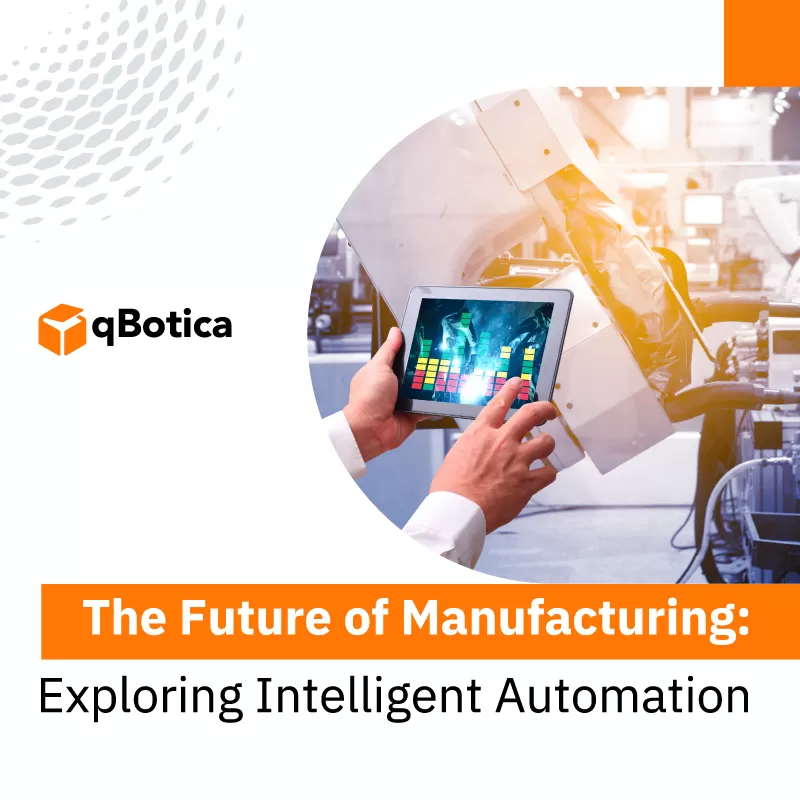
The world is changing day by day, and new technologies are introduced in order to make our life easier. In the case of the manufacturing industry, intelligent Automation is achieved through the combination of a number of components, including artificial intelligence (AI), robotics, machine learning, and the Internet of Things (IoT) among other emerging technologies to simplify and optimize the manufacturing process.
These new technologies have enabled manufacturers to change the focus of their businesses by automating what is required whilst concentrating on other important business aspects. It can also lead to multiple impacts on the business including increased productivity and even dramatic ones, and a better customer experience.
Discover how qBotica’s expertise in Intelligent Automation can revolutionize your manufacturing processes. Schedule a meeting with our experts today and unlock the potential of advanced technologies for your business’s success.
The Important Technologies that Spur Intelligent Automation
To begin with, Intelligent Automation can be described as a widespread application of automation technologies aimed at automatization and optimization of some tasks and processes in an intelligent and dynamic way. The concept entails the application of the subsequent technologies to carry out work with minimum human participation:
Artificial Intelligence (AI)
The most crucial element of Intelligent Automation is probably Artificial Intelligence. Due to machine learning and complicated algorithms, companies now have an opportunity to process various data types, such as text and numbers, and make predictions based on the information received and make wise but fast decisions. It is similar to dealing with an intelligent computer capable of thought and decision making without the need of a human being guiding him.
Robotic Process Automation (RPA)
Robotic process automation is the application of collaborative robots to do the routine tasks that are usually carried out by human beings. As an example, the robots might handle the filling of forms or even the extraction of information in the documents. RPA is inseparable with Artificial Intelligence to allow it to do sophisticated and more complicated tasks. That is, such robots will be similar to virtual assistants that will handle the routine tasks as humans are left to more creative and innovative work.
Connected Devices and Internet of Things (IoT)
The Internet of Things is not a novel phenomenon, yet it has lately begun to gain relevance because of its introduction into various aspects of our everyday existence. It entails linking ordinary items and equipment that we interact with in our daily lives to the internet so that they can transmit and get data.
The IoT is a critical component when it is related to intelligent Automation because it enables companies to optimize and enrich different processes. By doing so, companies are able to tie devices and sensors together to obtain real time information about various aspects of the brand: their operations, clientele, or even the environment in which the facilities are situated. All this will be later analyzed and processed by Artificial Intelligence to make informed decisions and automate some tasks.

Intelligent Automation of the Workforce
The implementation of Intelligent Automation is possible in multiple fields within a number of departments of a company. In terms of manufacturing it can transform the conventional methods to enhance efficiency and productivity among others as follows:
Maintenance
With the help of Intelligent Automation, it is now possible to predict the failure of equipment or when it requires maintenance by automatically analyzing real-time sensor and machine log data. Provided that companies can determine these issues beforehand, manufacturers can organize maintenance procedures, minimize idle time and maximise the working life of equipment.
Quality Control
Machine vision technology can be applied by intelligent automation systems to help inspect products in case of defects and provide the same quality, with minimum human inspection. This enhances accuracy, increases the speed of inspecting products and minimizes chances of errors or flawed products making it to the market.
Inventory Management
The Intelligent Automation is able to track inventory, monitor consumption patterns and automatically reorder in case the stock amount reaches a pre-set level. This maximizes the use of inventory, decreases stockouts and minimizes holding costs.
Supply Chain
To streamline the supply chain, Intelligent Automation has the ability to process data in multiple formats, suppliers, logistic partners, and the market demand. This involves the demand forecasting, inventory management, logistic route optimization, and simplification of the production time.
Decision-Making and Data Analytics
Smart automation will be able to interpret an extensive amount of data derived out of different sources including sensors, production systems and feedback of customers. This data analysis will help manufacturers to make decisions that are data-driven, streamline the processes, recognize areas to be improved, and improve general performance.
The Future of the Manufacturing Industry?
Intelligent Automation can be used to introduce amazing innovations in the manufacturing sector. With the equality of technology-based tools, such as Artificial Intelligence, Robotic Process Automation, and Internet of Things, businesses will be capable of transforming the conventional manufacturing methods and achieving an infinite number of advantages.
The introduction of AI solutions can simplify the work of manufacturers to analyze the different types of data and make knowledgeable decisions without using human instructions. Moreover, RPA is a valuable addition to AI because it is aimed at automating routine activities, whereas individuals are able to deal with more creative and innovative work.
Conversely, the IoT also links devices, objects and sensors which simplify data collection and analysis by companies. In such a manner, companies can probably optimize a number of areas in their performance, which can be maintenance, quality control or inventory management.
The manufacturing business is constantly changing regarding the application of Intelligent Automation, and the staff is able to reap numerous benefits, including the ones listed below:
- Avoided breakdown and maintenance procedures caused by their early identification of possible problems.
- Automated quality check-in of uniform quality of products without human involvement.
- Evidence-based perspectives on continuous improvement.
Businesses should evaluate the possible fields that they can redefine or improve by means of Intelligent Automation. In this manner, they will be able to target the possible weak areas and fortify the industry considering the highly competitive environment that we are existing in. In this manner, human workers can perhaps optimize their efficiency and productivity by emphasizing the tasks, which are more applicable to the business.
Conclusion
In this manner, intelligent automation comes at the expense of looking into the future. It is able to allow the enterprises to open up new frontiers of productivity, efficiency, and competitiveness in the fast changing global market. The possibilities of Intelligent Automation can perhaps allow the manufacturers to build a future where the possibilities of the industry can be transformed through innovation and Automation.
Leave a Reply